In Nils Elmark's blog on Mascha Kaléko, poet and femme fatale of Weimar Berlin, we revisit a poet of Mitteleuropa's metropolis. From her 1933 first publication at age 27 until her disbarment in 1935 and exile in New York in 1938, her work is richly redolent of Weimar Berlin.
In her poetry of the everyday, "Mascha" (Die Mascha) absorbed the urban life of Berlin, as 'lyrical stenographer' and chronicler of the city, from conveying the energy of the weekend's hit musical tune to Tuesday's lonely evening with a few photos of an ex-lover. From feverishly glowing hot rooves to the train departing at 09.07. (Das lyrische Stenogrammheft, 1933) "Ich sitz in meinen Stammcafé es ist schon spät. Ich gähne… Ich habe Sehnsucht nach René Und außerdem Migräne" ...I sit in the café ...It is late, I yawn ...I miss René ...but I have a migraine [transl. GC] Renate Hoffman's 2019 entry in the "Blättchen", entitled 'A reader's letter to Mascha', takes us wandering the streets of Berlin, window shopping through Tauentzien high street, and into the Emperor's Memorial Church on a July evening, and her lines of verse come alive. "Mit Mascha Kaléko schlendert man durch Berlins Straßen, über den Tauentzien und in einer Julinacht zur Gedächtniskirche. Plötzlich gewinnen ihre Verszeilen Leben: „Die Dächer glühn als lägen sie im Fieber. / Es schlägt der vielgerühmte Puls der Stadt. / Grell sticht Fassadenlicht. Und hoch darüber / Erscheint der Vollmond schlecht rasiert und matt …“ Schlägt der Puls der Stadt langsamer, zu vorgeschrittener Stunde, dann klingt der Abend in träger Müdigkeit aus: „Jetzt ruhn auch schon die letzten Großstadthäuser. / Im Tanzpalast ist die Musik verstummt / Bis auf den Boy, der einen Schlager summt. / Und hinter Schenkentüren wird es leiser. …“ („Spät nachts“) Melancholie schleicht sich ein und die Dichterin hegt quiemelige Gedanken: „Ich sitz in meinem Stammcafé / Es ist schon spät. Ich gähne … / Ich habe Sehnsucht nach René / Und außerdem Migräne. / Der große Blonde an der Bar / Schickt einen Brief. – Beim Lesen / Denke ich: zu spät. Vor einem Jahr / wär der mein Typ gewesen …“ Sie lässt den „Frühling über Berlin“ aufblühen und schildert einen „Sonntagmorgen“ in der Stadt. Es hat wohl seine Bewandtnis damit, dass man M. K. auch eine Dichterin der Großstadt nannte. The Berliner spring time blossoms, and a quiet Sunday morning in the city is signposted by the urban poet. Renate Hoffman 2019 https://das-blaettchen.de/2019/08/lesergruss-an-mascha-49410.html (also https://www.facebook.com/dasblaettchen)Thursday, December 03, 2020


Monday, April 27, 2015
Nomads Won't Stand Still for Their Portraits
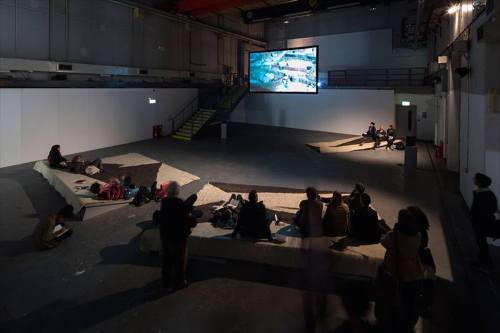
Potential Architecture - P3 Gallery
Pamela Buxton - Imagination Unfettered in RIBAJ
Gabriel Coxhead - Potential Architecture in Time Out
texts in collaboration with Cornelius Stiefenhofer and Joar Nango from the catalogue:


texts in collaboration with Cornelius Stiefenhofer and Joar Nango from the catalogue:
Monday, July 16, 2012
Mongolian Bling
I was aware of the beginnings of research on this project when I was in Ulaanbaatar, so it was great to learn recently that the film has just premiered in Perth, Australia.

http://mongolianbling.com/
Review
http://mongolianbling.com/
Review
Tuesday, December 13, 2011
Bare House

The book documents a project, curated by Annu Wilenius, involving many artists, writers and architects, about "the contemporary experience of dwelling and existence"
Bare Streets
In my chapter, I describe the banners I made for Pori, and their connection to the Bare House project, to the streets of peri-urban Ulaanbaatar, and to this blog about living as an "architect-teacher-trainer" in Ulaanbaatar.
"The future of architecture and streets in peri-urban Ulaanbaatar is in the hands of people like Gursed, Lkhagvaa, Uyanga and Delgerdalai..." (p.83)

The book also features the short film "City of Felt", in the accompanying DVD, and the works of fourteen others.
9 July 2008 with Uyanga and others
Sept 2007; how the year at the college began
Wednesday, October 19, 2011
Sunday, January 23, 2011
Volunteering
Where to go? What to do?
Boloormaa gives her view on what International Volunteers ought to think about before going to Mongolia - she suggests where she thinks they might be most useful, and explains a little about her work with Voluntary Service Overseas in Mongolia.
More about my time in Mongolia
Detailed report and story
Boloormaa gives her view on what International Volunteers ought to think about before going to Mongolia - she suggests where she thinks they might be most useful, and explains a little about her work with Voluntary Service Overseas in Mongolia.
More about my time in Mongolia
Detailed report and story
Wednesday, September 22, 2010
2010
The Bare House exhibition in Pori ended in early September, and the works are on their way back to the contributors or into storage, pending a future exhibition.
The publication for the 2009 Vienna Symposium, 'Along the Great Wall, China and Mongolia' with a paper on this UB architect-teacher-training project, is to be published in the near future.
The publication for the 2009 Vienna Symposium, 'Along the Great Wall, China and Mongolia' with a paper on this UB architect-teacher-training project, is to be published in the near future.
Monday, May 24, 2010
Paljas Talo - Bare House

(Bare House English - scroll down)
Blogi kertojan vuosi elävät Ulaanbaatar toiminut arkkitehti opettajien kouluttajana
Valitut tuo esiin,
Näkymät
Labyrintti
Pyörätuolin Tour
Kestävä matkailu
Live Projektit
Osallistumiskeinojen
Gregory Cowan, Pori 2010
Bannerit alla esillä Porin varten Bare House tehdä viime viestissä Mongolian. Sanat 2008 valmistunut, overlaid minun valokuvat kaupunkimaisema kaupungin muodostavat joukon "postikortteja" päässä Ulan Bator, tehty Ulan Batorissa vuonna 2010
Kaupunkisuunnittelu on jonkinlaista kehitystä
1 - Olemme hyvin, työtä
2 - kesä on tulossa Mongoliassa, lämpenee on mukava
3 - Aion tehdä töitä puolella, vauva on kunnossa
4 - huhtikuun rakennustyöt alkavat Mongoliassa mielestäni
5 - se siitä, hyvin, bye
Porin Taidemuseo Exhibition Catalogue (pdf)

This blog, exhibited Summer 2010 in Pori, Finland, narrates the year living in Ulaanbaatar working as architect teacher trainer (2007-2008).
selected highlights are;
Outlook
Labyrinth
Wheelchair Tour
Sustainable Tourism
Live Projects
Participatory Methods
Gregory Cowan, Pori 2010
The banners, like the one above, exhibited in Pori for Bare House (link below), carry a recent message, in Mongolian. The words of a 2008 graduate, overlaid on my photographs of the urban landscape of the city, form a set of 'greeting postcards' from Ulaanbaatar, made in a printing shop in Ulaanbaatar in May 2010
(bare house, bare street)
Urban design is a kind of development
1- we are fine, working
2- summer is coming in Mongolia, warming up will be nice
3- I will do some work on the side, baby is fine
4- from April building work will begin in Mongolia I think
5- that's about it, well, bye
Pori Art Museum Exhibition Catalogue (pdf)
Wednesday, February 03, 2010
Bare House - exhibition Pori, May 2010


Exhibition curated by Annu Wilenius in Pori
Banners, Drawings, Installation and Highlights of the year-long
'nomadologist' blog
including:
Live Projects
Participation
Sustainable Tourism
and
wheelchair tour of Ulaanbaatar streets
What will be the future for nomadic peri-urbanism in Ulaanbaatar?
Sunday, May 17, 2009
Along the Great Wall (Vienna) : цагаан хирэм дагуу
In May 2009 I presented this project and my work - and some lessons learned from it- at the symposium, Along The Great Wall: Architecture and Identity in China and Mongolia - at the kind invitation of Vienna University of Technology. Photos of the symposium are here, and the University may publish the proceedings.
Monday, April 06, 2009
learning from Ulaanbaatar
My purposes in Ulaanbaatar (2007-2008) were mainly to train architectural teachers, to teach students, to encourage the use of English, and to support the development of the Mongolian association of architects. My experience of professional development in Mongolia was very slow and incremental compared to my experience elsewhere.
I was often approached to work with community and activist groups in Ulaanbaatar,
and the college’s entrepreneurial approach created interesting architectural projects, despite needing to work within difficult constraints. Two ‘live’ studio projects – for Eco-Houses and a Childrens Camp – presented opportunities to study architectural processes of site analysis and brief development.
Over the year I was there, I believe the teachers enhanced their understanding about accessible and energy-efficient construction, about principles of project management, like time management and team planning, about site analysis and project planning, about organising client meetings and briefings, and about researching and writing architectural programme briefs for projects.
It will be a real challenge for these teachers - and for the association of architects in Mongolia - to continue to develop these processes.
In two live projects – ‘Sanzai Eco-houses’ and ‘Yarmag Children’s Camp’- newly trained
architects (like Mr, Lhkagvaa and Mr. Gursed) and architecture students aimed to incorporate participatory practice in their design projects, consulting with clients, and exploring options for site analysis.
Questions raised in an outside analysis of these processes by students at Sheffield University
included, for example;
How is traditional architecture valued by clients and designers of such projects, in the development of these peri-urban areas?
Can traditional Mongolian Gers still be considered an effective option for rapid-deployment, sustainable, informal settlement?
These researches are now being pursued locally by Purev-Erdene Ershuu at MUST and by Michael Fuerst, with the technical support of the international agency GTZ.
There are many lessons to be learned from the issues of peri-urban settlement in Mongolia, and further suggestions could be made on which issues could be further explored in future work on architecture in development being undertaken in Mongolia.
I was often approached to work with community and activist groups in Ulaanbaatar,
and the college’s entrepreneurial approach created interesting architectural projects, despite needing to work within difficult constraints. Two ‘live’ studio projects – for Eco-Houses and a Childrens Camp – presented opportunities to study architectural processes of site analysis and brief development.
Over the year I was there, I believe the teachers enhanced their understanding about accessible and energy-efficient construction, about principles of project management, like time management and team planning, about site analysis and project planning, about organising client meetings and briefings, and about researching and writing architectural programme briefs for projects.
It will be a real challenge for these teachers - and for the association of architects in Mongolia - to continue to develop these processes.
In two live projects – ‘Sanzai Eco-houses’ and ‘Yarmag Children’s Camp’- newly trained
architects (like Mr, Lhkagvaa and Mr. Gursed) and architecture students aimed to incorporate participatory practice in their design projects, consulting with clients, and exploring options for site analysis.
Questions raised in an outside analysis of these processes by students at Sheffield University
included, for example;
How is traditional architecture valued by clients and designers of such projects, in the development of these peri-urban areas?
Can traditional Mongolian Gers still be considered an effective option for rapid-deployment, sustainable, informal settlement?
These researches are now being pursued locally by Purev-Erdene Ershuu at MUST and by Michael Fuerst, with the technical support of the international agency GTZ.
There are many lessons to be learned from the issues of peri-urban settlement in Mongolia, and further suggestions could be made on which issues could be further explored in future work on architecture in development being undertaken in Mongolia.
Saturday, January 24, 2009
architect teacher trainer


Related:
Vienna University of Technology Comparative Architectural Research
Sheffield Lines of Flight (workshop), Alternative Architectural Praxis
London Met MA Architecture of Rapid Change and Scarce Resources
UCL Building and Urban Design in Development
Oxford Brookes Centre for Development and Emergency Practice
Kingston Design for Development
Sunday, January 11, 2009
Informal Architectures, Participatory Practices
Supreeya Wungpatcharapon of PhD research group Lines of Flight at Sheffield University (and Doina Petrescu) arranged that I present Seminar 09 there: Informal Architectures and Participatory Practices
Thursday, December 04, 2008
Tuesday, September 23, 2008
Highlights
In short, staff "...developed their understanding about Accessible and Energy-Efficient construction, about Project Management principles, like time management and team planning, about Site Analysis and Architectural Project Planning, how to organise client meetings and briefings, and how to research and write architectural programme briefs for projects."
(see Change - 434 words)
The stated project aims were
"to:
1. Support and develop the skills of teachers in the college
2. Teach architecture to architecture students
3. Cooperate on development of the architecture and construction professions in Mongolia
4. Encourage teachers and students to learn English as a tool for professional development
5. Assist in the developing the architecture profession.."
(see the Report -1929 words)
CTC (pictures)


(see Change - 434 words)
The stated project aims were
"to:
1. Support and develop the skills of teachers in the college
2. Teach architecture to architecture students
3. Cooperate on development of the architecture and construction professions in Mongolia
4. Encourage teachers and students to learn English as a tool for professional development
5. Assist in the developing the architecture profession.."
(see the Report -1929 words)
CTC (pictures)


Sunday, September 14, 2008
Nomadologist milestone
 Upon arrival at Pudong Airport, I will have completed my journey from London to the 'Far East', via Ulaanbaatar, which started in July last year. Travelling by train halfway across the world has been a great personal and developmental journey.
The year working on architectural education in central Asia, and learning about and practicing 'international development' is fresh in my mind, and I do not yet know what it will all mean in the long term. I have seen some interesting job opportunities and been offered work on an RIBA project for a week. A new research project on public space in London also caught my attention. I am thinking about how to bring my experience to bear in my future work, and have promised to report reflections on this to VSO one year hence.
"You have achieved nothing" - the farewell from the drunken Director of the college on the day before I left - still irks me, although I know it was meant 'ironically'. I was pleased that an experienced and highly capable Mongolian colleague, someone who is at arms length from the college, has kindly undertaken to translate the final report and my 'significant change' story. But the language alone will not convey the messages of the report to the 'stakeholders'. Understandably, they will be reluctant to consider the implications of sustained investment- much needed time planning, staff development and pursuing processes of organisational change, as they are busy in the everyday life of teaching (and administering) in a growing college, and finishing construction of the new college building.
Correspondents and colleagues have recently written to me and supported the blog project and I look forward to seeing what can come from it. As I leave for a visit to my birthplace, I am reading 'Wolf Totem', a novel about Mongolia which brings ancient layers of animal myth and nomadic practices into focus. With my recent experience I am able to continue learning more about the sedentary and nomadic ways of life and survival.
Thursday, September 11, 2008
Accessible, Mobile in China
 After passing paralympian tourists circling the Forbidden City (pic) on my bicycle in Beijing, I am in Shanghai, a city of 15-20 million whose sheer population density prompts amazing adaptations for mobility of the most diverse modes of transport of goods through the city. The subway system is incredibly complex and the bicycle seems to be for traffic experts, so I have been riding in taxis, trying to comprehend this city's 'urbanatomy'. I visited the Urban Planning museum (Youtube) with its enormous model of Shanghai. The form and the presentations are mostly spectacular, but I wonder about the real cultural processes of renewal, regeneration and 'development' here. I thought perhaps I might take to the river, for another perspective.
After leaving landlocked Mongolia, I have also just read, on Tour Watch, of some soon-to-be published "Waypoint - Backstrom" Principles for accessible maritime architecture, and it reminded me of architects' role in widening the accessibility of environments, not only on land in the developing world but also on water. I enjoyed sailing on the Swan River on my last visit to my home town Perth, where I will visit again this month.
Excerpt from the Waypoint - Backstrom Principles:
1) Begin with Universal Design
The principles of Universal Design are an essential element of seaworthiness. Assumptions of the abilities (physical, mental, or sensory functionality) of crew or passengers as constant over time in any single individual or uniform throughout the population of owners and users of the watercraft throughout its lifespan are to be questioned.
2) Design for Self-Sufficiency
Watercraft are the insertion of a terrestrial into a maritime environment. Pay attention to both social sustainability (Universal Design) and environmental sustainability (green design).
3) Design for Extraordinary Conditions
Maritime practice traditionally assigns clearly-defined shipboard roles and responsibilities. Design assumptions follow. Assumptions about the abilities (physical, mental, or sensory) of the idealized role-holder as they are designed into products, spaces, and practices may prove to be disastrous in emergency situations.
4) Design for Modularity and Revision
While a core tenet of Universal Design is that the design be sufficient "without special or separate design" the frequency of maintenance necessary for watercraft, especially in a saltwater environment, leads to frequent opportunities for upgrade to accommodate the range of abilities in crew and passengers.
5) Design for Seamless Intermodal Transfer
Sophisticated and efficient systems have been developed to load and unload watercraft, haul them ashore, or transport them.
- see Tour Watch
more information:
The Rolling Rains Report
Dr. Scott Rains, Consultant, San Jose, CA srains@oco.net ,
Sherri Backstrom, Director Waypoint Yacht Charter Services
sherri@waypointcharter.com
4648 Lakeway Drive Bellingham, WA 98229
After Mongolia, I have again been appreciating bicycles - a simple and ingenious form of urban transport ;
Some links -
Recently featured in AJ, The Architects Journal
Alex Moulton, creator of Moulton Bicycles a favourite of Reyner Banham and Norman Foster and
Improving London's Bicycle Spaces - an ideas competition
and from Banff's Art Centre; Art on a Bicycle
Songbike - Touring Banff on a bicycle
Thursday, September 04, 2008
Forbidden City
 I read some of Master Chu's 'homilies for families' while in UB, preparing for China. Recently, arriving in Beijing, I also read this, cited in Sidh Sintusingha's noteworthy editorial musings for Architects for Peace; "The most important thing in the Olympic Games is not to win but to take part, just as the most important thing in life is not the triumph but the struggle. The essential thing is not to have conquered but to have fought well." (Olympic creed, Pierre de Coubertin) At AfP I also read great news of Sonya Redman's (UNSW) Berkeley Essay Prize win for 'Shaping Identity and Place in Australian Indigenous Housing'.) I read about the list of schools participating in the World Architecture Festival, originally billed as the 'ten of the world's best'. I don't quite understand the criteria for this little league table when I see the list; Bartlett, University College of London (UK); Hafencuty Universitat (Germany) -sic; School of Design and Environment (Singapore); Ravensbourne College (UK); Kazan Architectural University (Russia); Escuela Técnica Superior de Arquitectura de la Universidad CEU San Pablo (Spain) (..six schools, not ten...)
Anyway, I am glad I didn't come to Beijing for the Olympic Games, but I feel like I have fought well for the past year, albeit in a far less glamorous way. The city seems relaxed in the calm after the games and in the lead up to the paralympics. I even feel slightly guilty for enjoying the effortless architectural informality of the labyrinthine Beijing Hutongs. In my mind I have been trying to compare them to the ger districts of Ulaanbaatar... Meanwhile I have been to see the Ancient Architecture Museum in Beijing, and the spectacular 'Birdsnest' Stadium, photographed across a highway. I feel 'philosophical' about the year in Mongolia and have made my first speaking appointment to talk about it near Perth on the first of October.
I have realised the old city and the new city of Beijing are at loggerheads, as I experienced while circumnavigating an enormous city block 'under renewal' on foot - in order to get to the beautiful Ancient Architecture Museum, walled deep inside the super-block. Using the internet here makes for another wearying experience, waiting for the many filters and firewalls to check through every site I request. I'm going back to the Hutongs.
Thursday, August 28, 2008
Significant Change
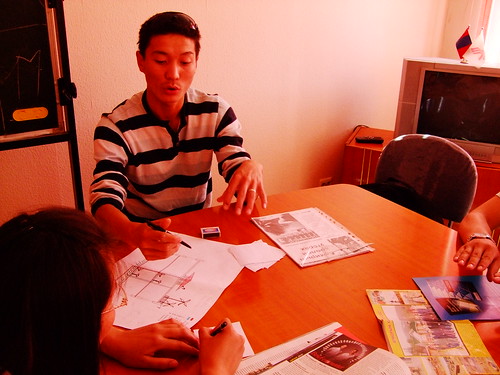 Architect Teacher Trainer; Small, Significant Change
In the VSO placement with the Mongolian Construction Technology College, development occurred in small but hopefully valuable ways. I was consulted relatively autonomously by the Mongolian Construction Ministry, Mongolian Wheelchair Citizens (МТИХ), World Vision (Bayankhoshuu), and the Gender Centre for Sustainable Development in the 8th Khoroo. But the two live architectural projects we undertook collaboratively in the college, in Sanzai and Yarmag, provided the most concrete opportunities for training architect teachers. The work can potentially have a long term impact with the existing teachers - Bolormaa, Tsenguune, Ariunaa, Hashbayar - and new teachers, Lhagva and Gursed (with their students Delger-Dalai and Tumen Od). The former developed their understanding about Accessible and Energy-Efficient construction, about Project Management principles, like time management and team planning, about Site Analysis and Architectural Project Planning, how to organise client meetings and briefings, and how to research and write architectural programme briefs for projects.
I feel confident that with support from the college, the teachers, Bolormaa, Tsenguune, Ariunaa, and Hashbayar will be able to continue the training we commenced over the past year in
- teaching research,
- languages for internationalisation,
- CV clinics, and
- internet based tools (flickr, blogging, google earth, wikipedia)
apploied to architectural and construction education.
Teachers Bolormaa and Tsengel-Oyun assisted in training with Suvdmaa (English teacher) and Bolortsetseg (Architect teacher) from the Technical and Technology College (TTC) in comparatively mapping degree curricula respectively of MCTC and TTC. This will develop ownership of architecture degree curricula in Ulaanbaatar which will need major reworking in the coming years. The latter college has recently applied to work with VSO. I would strongly encourage these people to continue to work together on professional development, and in future to extend their knowledge to develop the Mongolian Association of Architects.
New teachers have been recruited to MCTC and these will need guidance and encouragement in their professional development from the above trained teachers. I recommend the staff continue to work with Rob van Waardenburg VSO and that new consultants or volunteers will continue the professional development work for which the college and teachers should have ownership and be proud.
The college has been building a new five storey classroom building in the 21st district, with students labouring as practical trainees. The directors and architects agreed in January - among other suggested design and safety improvements - to make the basement and first (ground) levels wheelchair/barrow accessible by ramps. Access to construction and architectural education will not only be physically improved in this case, but also a process has begun for more participative and inclusive building design and college management.
Tuesday, August 26, 2008
Tsambagarav
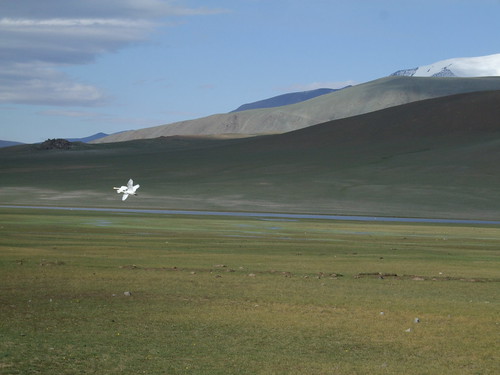 As a reward for enduring a year in Ulaanbaatar, we made a trip to see Tsambagarav in Mongolia's Altai mountains in the remote west. Flying in to Khovd over the mountains, I read Sunand Prasad's piece about the UIA (International Union of Architects) and remembered that my Mongolian colleagues (Dagshigdorj et al of the Mongolian Association of Architects) visiting UIA Turin had declined an invitation to attend a RIBA reception in my stead - at a beautiful 16th century Palazzo there. Thinking of their reluctance reminded me of my work, my final report in progress and exit interview on the 27th.
After driving by jeep past the impressive snow-capped Tsambagarav (4400m) to stay in a Khazak Mongolian family Ger, I noticed the family's work programme. Six hours of each day - 5am-8am and 5pm-8pm - spent milking thirty yaks for about 100 litres of milk, from which they make various cheeses, curds and yogurt. Yak wool/hair and crafts supplement the income from the milk products. I enjoyed the evening meal "five fingers" of dried and boiled yak meat mixed with pasta sheets just made by a ten year old girl. Delicious yoghurt followed. By the light of a single solar powered lamp in the Ger, I flicked through the letters of RIBA Journal, reading Iain Borden defend the Bartlett, then a review of "Instant Cities".
After giving the farmer host and his saddle a lift to a valley where he thought he might find his horse, we travelled north and stayed a night with another Khazak family in a Ger by a river near Altantsogs village, where thirty goats were milked once a day to produce 18 litres. While I was relaxing in the ger, a farmer slaughtered a goat outside the door and then unexpectedly brought it in to hang in our ger for butchering. A slightly threatening old man - a drunken Khazak relative - argued with me in Mongolian that Australia had been part of Germany. (In vain I painstakingly distinguished Austria from Australia)
Staying in Olgii town centre's 'Green Garden' Ger Park with its delightful gardens provided an opportunity to unwind. It was the farthest point from UB. Reconvening in our ger with two German trans-Mongolia cyclists we had earlier seen climbing Tsambagarav, two Spanish cyclists (project) from the Turkish restaurant and a backpacking English kindy teacher from UB joined in for a little spontaneous party.
Subscribe to:
Posts (Atom)


