Ulaanbaatar has rather chaotic traffic and infrastructure. It is known for open manhole covers, which fortunately, are visible in the strong sunlight in summer, but turn nasty when covered with a sheet of cardboard and a thin layer of snow in winter. Apparently in the past a VSO stepped right into one from a parked car and broke her leg. It is understandable then that injury, espacially among the poor, is a common cause of disability.
We attended a briefing at the Umbrella organisation for disabled people's groups which was enlightening. The medical model of disability popularly understood here, implying proscribed 'treatment'- is in contrast with the social model of disability I have begun to understand - as a form of exclusion or denial of access from public and private space. The Umbrella organisation of disability groups had several wheelchair users and crutch users (the latter visibly more prevalent here in Mongolia) from the twently-odd advocacy groups working in the building, and after years, had had a ramp installed in the last week, allowing users to enter the premises without being manhandled through the door.
I spoke to the chair of the disabled businesspersons association while there. In future, I hope it might be possible to arrange a meeting between their representative and some construction teachers, to discuss the background to livelihoods and building accessibility in Mongolia for physically disabled users.
Wednesday, August 29, 2007


Monday, August 20, 2007
Ulaanbaatar dawn

From beautiful lake Baikal we returned to Irkutsk and I wandered along the banks of the Angara before boarding the evening train for the Trans-Mongolian, the final section of train journey. Ulan Ude and the southern shore of Lake Baikal passed in the night and I awoke to see another lake in Buryatia.
The Russian border officials turned the train inside out, and we waited interminably in Sukhbaatar also. The latter was distinctly friendlier, however, and I began to warm to the steppe landscape and sounds outside. It was another night before we arrived in Ulaanbaatar, a dusky light covered the city and the ger suburbs stretching out for miles. Pulling into the station, I savoured the arrival. Our friend Sarah was waiting on the platform and we went to a car and traversed a surreal other-worldly city to arrive at the VSO building and vols room before 7am.
As colleagues gradually appeared, we washed and hungrily ate lunch in welcoming surroundings, before venturing on a bus to a ger district where the Womens farming Coop hosted a party for departing volunteer Maija. The snarling ger-camp dog contrasted with the idyllic grassy picnic spot next to crops and chickens and gers. But the mountains all around are a powerful backdrop there as well as here in the city centre.
Thursday, August 16, 2007
Siberia

We are in Irkutsk, having just returned from the tiny village of Huzir on the Island of Olkhon on Lake Baikal. My friend here tells me the Island was previously Buryati land, increasingly inhabited by Russian settlers. It now seems to be a popular (eco)tourism destination. We stayed in the guest house, made an excursion to the northern tip of the island, ate local food and took a banya (sauna).
Although I thought we had left the 'West', the border condition is very topical here, with Irkutsk district to the west of Lake Baikal and the Buryati republic to the east. This friend Irina is studying languages at the specialist institute of the University here in Irkutsk, where there is apparently a strong interest in reviving Buryati language and culture, and better resources than in the Buryati capital city of Ulan Ude.
When we pass through the city of Ulan Ude tomorrow (Friday) on the train, we will be still closer to the Buryati country which is the land of the descendants of Genghis Khan. We expect to tarry at the Mongolian border for several hours before continuing to our final destination on Saturday.
Wednesday, August 08, 2007
Yekaterinburg

After dropping our bags we ventured into the night, still daylight. Podval, a music club recomended to us in the south of the city, was difficult to locate, even with the full address, but after a partial journey by no. 5 tram, then walking along highways and talking to strangers chatting on railway tracks, we got to the door, were bounced, and then admitted after appealing to reception at the hotel next door. We had some limited conversations and exchanges of Vodka with other guests before finding our way back to the hotel by Taxi.
The promised tour of city attractions (aka Достопримеуатепьности) incorporated visits to the Church of the Blood, Town Square and the opportunity to tie a ribbon to a tree at Ekaterina's tomb, to increase the likelihood of returning. At a public square next to the dammed river is a statue of the city founders, known to our guides as 'Beavis + Butthead' and the square was being put to good use by skateboarders. Nearby was the monument (apparently unique in the world) of the computer keyboard. In light of our impending departure from Europe, I thought I would try stepping on the 'undo' command.
Wednesday evening, in holiday mode, we visited a Latin club 'Gavana' with Dasha, Katja and friends. After some Russian beer and latin dancing, people in the club began to be noticeably more exotic and oriental looking. The next day, wet, was passed looking at the Mineralogical Museum before killing time in the internet cafe to await the 2345 Trans-Sib connection.
москва and the Урап; train no.16

Moscow seems like London, but with signs in cyrillic. The Metro system is incredible, and much larger than LU. The station halls are like ballrooms, with chandeliers and sculptures, sparse signage, but no unnecessary frills like advertising - or arrival time signs. For me, these halls made a great impression about the city.
The Schushev Architecture Museum had a reasonable exhibition dedicated to a recently deceased 40-ish architect, but the students we met there were a find. Саща and Ариана gave us a brilliant city tour, from Arbatskaya Metro to a Constructivist Fuel Station and ArtPlay interior showrooms, after which we had a meal at very cool Keks.
The souvenir market in the northern suburbs was a strange Disneyesque theme park for bus tourists but had a poetic quality. I am glad we took time to get an overview of the city and river from the lookout point near from the University, where there was a movie shoot going on.
We arrived at the Ural train just in time, and it was beautifully decorated and very efficiently staffed. The train climbed slowly east and into the mountains and we got to know our co-passengers, Ekaterinburgers, a journalist and coach, the latter of whom introduced his daughters. Dasha and Katya had been competing abroad in athletics (including an event wearing stiletto heels) were later to show us around Ekaterinburg, including the night life. The Ural train was very comfortable, with a kitsch overpriced restaurant car, but the arrival in Ekaterinburg welcome. The crumbling Hotel Sverdlovsk opposite the station provided adequate accommodation and convenient services.
Monday, August 06, 2007
to Berlin and Warschawa

The overnight train from Vienna Westbahnhof arrived in time for breakfast at the very impressive Berlin Hauptbahnhof. Peregrinations followed and led to the Fernsehturm, but the sojourn to KMA 36 (Karl Marx Allee) gave a taste of Ost Berlin, especially Kafe Moscow and the adjacent bar. The interior of our chosen accomodation at Pension Funk was definitely in keeping with ths 'Ostalgic' theme, albeit close to the ritzy Ku'damm.
Aptly named Ost-West, the Berlin - Warsaw train led to Warshawa Centralny, where our delightful co-passenger Agnieschka, (who at the border had kindly but unsuccessfully attempted to negotiate against the eviction of our Egyptian co-passenger without a visa) took us through the labyrinth of shops to take us to Polish breakfast.
At Warschawa Wschodia station I felt we were truly entering eastern Europe. The onward Warsaw to Moscow journey incorporated an impressive bogey change at Brest (Belorus). With passengers necks craning from the windows, the carriages were deftly distributed between sets of hoists in the shed-workshop and a small army of mechanics slid the first set of bogeys out and filed the new set in, manually halting each in the correct position before lowering the wagons again.
I did not awaken for the stop at Minsk in the middle of the night but enjoyed the country villages from the window after breakfast. As we reached Moscow, there was a tangle of stations and highways and we drew to a halt in the chaos of Belorusskaja station.
Now the challenge of finding the way with signs in cyrillic like this.. Настройки сообщения
Sunday, July 29, 2007
Vienna

Reaching Vienna, where I lived several years ago and where the Ottomans besieged the city in both 1529 and 1683, feels like crossing some sort of threshold.
I revisited the Ring and Naschmarkt food market, which is still on a par with the Borough, and met with friends and their growing families. In the Prückl cafe this morning I was able to take time to catch up on news in Die Presse and to briefly contemplate the language I will use and the edge of Europe we will soon traverse.
Traditional Mongolian script originated from Sogdian letters of Aramaic origin, used until 1941 in Mongolia when an adapted cyrillic alphabet was adopted; still under the MPR (Mongolian People's Republic was formed 1924)and which is still used after the democratic revolution of 1990.
Tonight we board a train for Berlin and the East will grow closer still than in the Naschmarkt.
Tuesday, July 24, 2007
Training

We have begun the train journey towards Ulaanbaatar by Eurostar from London to Paris, then by sleeper to Rome, to Naples, Sorrento and now Florence. Drawing statues and buildings in Piazza delle Signorie today I was thinking about Western European history, having sat in the same spot 20 years ago, and how much I have still to learn about Mongolia. I have a copy of "Modern Mongolia a Concise History" with me (Tsetsendambyn Batbayar UB 2002) and have been discovering facts like ..
. Mongolia is similar in land size to Alaska
. It has 257 cloudless days per annum on average
. 1% of the land is arable
. 8 to 10% is forested
. the rest is pasture including semi'desert
Batbayar also points out that the Mongol people have nothing in common with the Chinese in their way of life or language. 90% of the population of Mongolia is made up of subgroups of the Mongol nationality, the largest being Khalka.
This will be quite a change for me from my home London, which I enjoy for being cosmopolitan and multicultural. However the isolation of Ulaanbaatar and its time zone should be points of some familiarity in relation to Perth. The summer in Italy, surrounded by travelling Italian, German, Australian and English folk etc with good coffee, summer berries and pizza will become stranger as we move east.
Later this week, en route from Venice to Berlin, we will stay in Vienna, minding some friends' cats, Gina and Kisses.
Itinerary
Tuesday 17 July London to Paris
Wednesday 18 July Paris to Rome (overnight)
Saturday 21 July Rome to Naples
Sunday 22 July Naples to Florence
Wednesday 25 July Florence to Venice
Wednesday 25 July Venice to Vienna (overnight)
Sunday 29 July Vienna to Berlin (overnight)
Tuesday 31 July Berlin to Warsaw (overnight)
Wednesday 1 Aug Warsaw to Moscow (overnight)
Saturday 4 Aug Moscow to Yekaterinburg (overnight)
Wednesday 8 Aug Yekaterinburg to Novosibirsk (overnight)
Friday 10 Aug Novosibirsk to Irkutsk (overnight)
Thursday 16 Aug Irkutsk to Ulaanbaatar (overnight)
Saturday 18 Aug Ulaanbaatar
Wednesday 18 July Paris to Rome (overnight)
Saturday 21 July Rome to Naples
Sunday 22 July Naples to Florence
Wednesday 25 July Florence to Venice
Wednesday 25 July Venice to Vienna (overnight)
Sunday 29 July Vienna to Berlin (overnight)
Tuesday 31 July Berlin to Warsaw (overnight)
Wednesday 1 Aug Warsaw to Moscow (overnight)
Saturday 4 Aug Moscow to Yekaterinburg (overnight)
Wednesday 8 Aug Yekaterinburg to Novosibirsk (overnight)
Friday 10 Aug Novosibirsk to Irkutsk (overnight)
Thursday 16 Aug Irkutsk to Ulaanbaatar (overnight)
Saturday 18 Aug Ulaanbaatar
Friday, July 13, 2007
Ulaanbaatar preparations
I travel to the Mongolian Capital, Ulaanbaatar in August, to work as Architecture Teacher Trainer at the independent Construction Technology College, БАРИЛГЫН ТЕХНОЛОГИЙН КОЛЛЕЖ (www.ctc.edu.mn).
Mongolia is a developing country, and I have been reading in the VSO notes that forty percent of the country’s population of 2.7 million people currently live below the poverty line. 34 percent of the population depend directly on livestock for their livelihoods, and a further 26 percent is indirectly dependent upon livestock. With 33 million domestic animals, Mongolia is known as a 'land of livestock'; most of the population are traditional nomadic herders. I found it interesting that huge sections of the population today continue to live in the Ger, the traditional felt circular dwelling of choice in Mongolia for more than 1,000 years.
The country is rich in minerals such as oil, coal and gas, and while mining is hugely important to the economy, it is becoming apparent that recent development in industry has created significant environmental damage. The environmental movement in Mongolia appeared in the world media in April 2007. I suddenly noticed in a London newspaper an award of what is reputedly the world’s biggest environmental prize to Tsetsegee Munkhbayar, who inspired the formation of the Mongolia Nature Protection Coalition. The Goldman Environmental Prize is apparently the world’s biggest accolade for grassroots environmental activists. I can imagine rural communities in Mongolia are undergoing massive change in the country’s transition from a centralized command economy to a market economy. Many state-owned factories have closed, with losses of jobs and the poor moving back to the land, further stretching the already depleted resources of the countryside. The work of Tstsegee Munkhbayar has increased the profile of a popular movement to restore the vitally important Onggi river. (www.goldmanprize.org)
Mongolia is a developing country, and I have been reading in the VSO notes that forty percent of the country’s population of 2.7 million people currently live below the poverty line. 34 percent of the population depend directly on livestock for their livelihoods, and a further 26 percent is indirectly dependent upon livestock. With 33 million domestic animals, Mongolia is known as a 'land of livestock'; most of the population are traditional nomadic herders. I found it interesting that huge sections of the population today continue to live in the Ger, the traditional felt circular dwelling of choice in Mongolia for more than 1,000 years.
The country is rich in minerals such as oil, coal and gas, and while mining is hugely important to the economy, it is becoming apparent that recent development in industry has created significant environmental damage. The environmental movement in Mongolia appeared in the world media in April 2007. I suddenly noticed in a London newspaper an award of what is reputedly the world’s biggest environmental prize to Tsetsegee Munkhbayar, who inspired the formation of the Mongolia Nature Protection Coalition. The Goldman Environmental Prize is apparently the world’s biggest accolade for grassroots environmental activists. I can imagine rural communities in Mongolia are undergoing massive change in the country’s transition from a centralized command economy to a market economy. Many state-owned factories have closed, with losses of jobs and the poor moving back to the land, further stretching the already depleted resources of the countryside. The work of Tstsegee Munkhbayar has increased the profile of a popular movement to restore the vitally important Onggi river. (www.goldmanprize.org)
Itinerary
Itinerary
Tuesday 17 July London to Paris
Wednesday 18 July Paris to Rome (overnight)
Saturday 21 July Rome to Naples
Sunday 22 July Naples to Florence
Wednesday 25 July Florence to Venice
Wednesday 25 July Venice to Vienna (overnight)
Sunday 29 July Vienna to Berlin (overnight)
Tuesday 31 July Berlin to Warsaw (overnight)
Wednesday 1 Aug Warsaw to Moscow (overnight)
Saturday 4 Aug Moscow to Yekaterinburg (overnight)
Wednesday 8 Aug Yekaterinburg to Novosibirsk (overnight)
Friday 10 Aug Novosibirsk to Irkutsk (overnight)
Thursday 16 Aug Irkutsk to Ulaanbaatar (overnight)
Saturday 18 Aug Ulaanbaatar
Tuesday 17 July London to Paris
Wednesday 18 July Paris to Rome (overnight)
Saturday 21 July Rome to Naples
Sunday 22 July Naples to Florence
Wednesday 25 July Florence to Venice
Wednesday 25 July Venice to Vienna (overnight)
Sunday 29 July Vienna to Berlin (overnight)
Tuesday 31 July Berlin to Warsaw (overnight)
Wednesday 1 Aug Warsaw to Moscow (overnight)
Saturday 4 Aug Moscow to Yekaterinburg (overnight)
Wednesday 8 Aug Yekaterinburg to Novosibirsk (overnight)
Friday 10 Aug Novosibirsk to Irkutsk (overnight)
Thursday 16 Aug Irkutsk to Ulaanbaatar (overnight)
Saturday 18 Aug Ulaanbaatar
Friday, May 18, 2007

Wednesday, January 17, 2007
Friday, December 22, 2006
Friday, July 14, 2006
Bikes and urban space
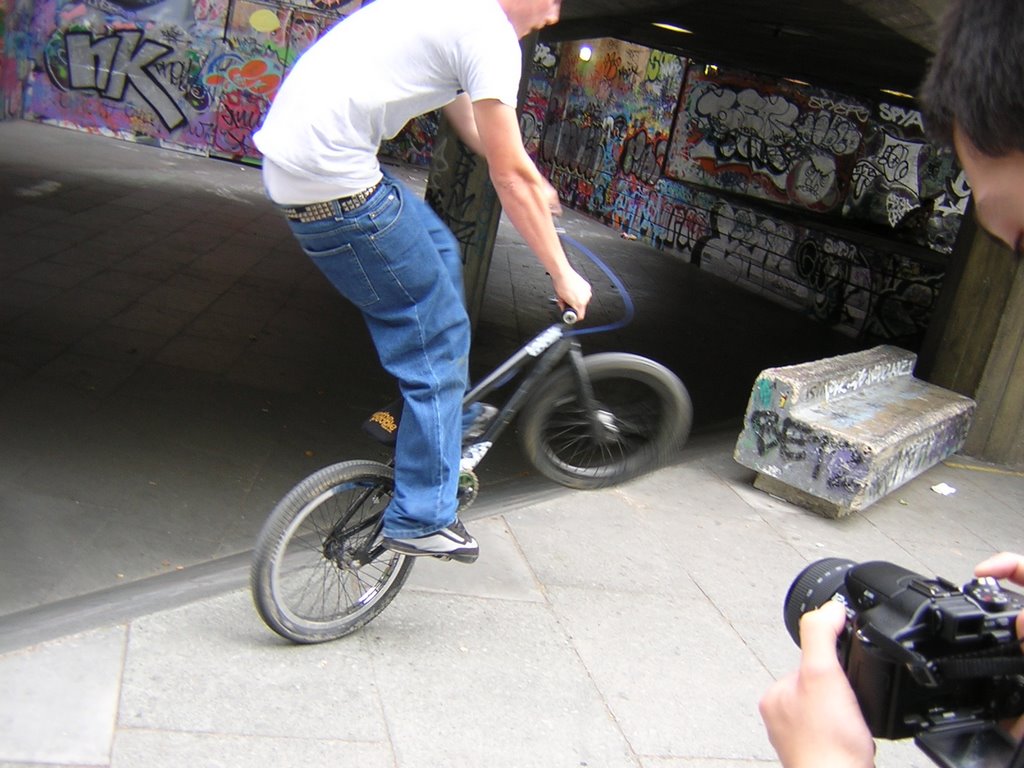
Recently saw some cyclists putting the spaces below the Hayward at London's Southbank to ingenious use.
Resonance FM's recent interview for the Bike Show with the artist Julia Lohmann impressed me; combining journeying across London with animal ethics, sustainability and an impromptu chat along the way with some bicycle space hijackers.

Clare
Monday, July 03, 2006
Twenty First Century Thinking

Nineteenth century - style planning principles for the 2012 Olympics suggest replacing this sustainable urban garden with a footpath.
"A campaign to save century-old allotments due to be bulldozed to make way for Olympic development is gathering momentum.
According to the revised masterplan for the Olympic site, the Manor Gardening Society allotments in Waterden Road, Stratford, will be replaced by a footpath.
Campaigners say the strategy will destroy a working example of a sustainable environment, a diverse community and source of local food production contradicting the promised Olympic legacy."
Full Story
Observer, Monday 3 July
Green Belt Movement - Wangari Matthai
Saturday, July 01, 2006
More Music - less fighting!


Ronnie Shellist is doing some nice work on blues harmonica, not a genre I usually follow; but this is great.
Even better, and with the simplest instruments, check out this percussionist playing batacuda des baldes. Arm power. Wow.
Friday, June 30, 2006
Does Architecture really rock?

Famous in Japan They were funny and the lyrics were entertaining. Nice that they don't take the whole thing too seriously.
Menage a Trois won some sort of prize
Saturday, May 27, 2006
You tube favourites
You Tube video faves...
Veruca Salt's costumey bicycles in Shutterbug (with very 90's music..)
A humorous and poignant animated piece (5 minutes): The Immigration Debate
This music on the analog synthesiser is quite cool; a guy called MooTBooXLe.
Veruca Salt's costumey bicycles in Shutterbug (with very 90's music..)
A humorous and poignant animated piece (5 minutes): The Immigration Debate
This music on the analog synthesiser is quite cool; a guy called MooTBooXLe.
Thanks for sponsoring me to cycle to Brighton
Thank you for supporting me on the gruelling ride with Team Brompton to benefit British Heart Foundation...
(Sponsorship Page)
(Sponsorship Page)
Subscribe to:
Posts (Atom)


