The midpoint of my intended stay passed yesterday. When asked by new teacher Tsenguune about my impression at that moment, I said that I percieved progress. A few days ago I came upon a man fallen on his back at the local bus stop. I was alone but was able to raise him to his feet. In contrast to the man described in November, he walked away without being hit by traffic. My cousin had written to empathise, concerned about the previous instance, and I can now report a better outcome.
I have recently made several visits to the state Construction College, helping to prepare their submission for an Asia Pacific accreditation body (APACC), and providing me with quite a detailed understanding of the staffing, management and operation of that long-established college. The terms "benchmarked institution" and "ergekh kholboo", for example, raised issues for linguistic and cultural comparison, as did the question of international publications about Research & Development projects in that college. I also learned something about benchmarking in the Technical and Vocational Education and Training sector.
Tuesday, February 19, 2008


Friday, February 15, 2008
Walking again
In the ger district this morning, two small girls in pink quilted jackets waited on a hill for the local shop to open, and as I walked by, they called down to me in English.. "hello.........................good bye". It occured to me that in a few days it will be half way through my placement here. Today I felt that it was becoming warm enough (-17C max) by late morning to walk to work, so spring begins. The little bridge was stripped down to two steel beams again, the boards probably taken for somebody's fire again, people were gathering at the informal taxi stand, and there were a few people at the water tank. A weathered-looking couple carried a large plastic water container down hill, each holding one end of a stick threaded through the handle. The sky is bright blue and there is still a lot of compacted snow lying. The curled up corpse of a tiny dog caught my eye as I was walking and counting months.
Yesterday evening, with six Mongolian friends, I went to a local cafe for our 'English speakers club', established last year with Ruth, a VSO language teacher trainer, and drank Sea Buckthorn tea, while making mutual introductions, comparing jobs and reviewing Tsagaan Sar in English.
Im Ger Bezirk heute morgen, zwei kleine Maedchen in rosfarbigen Jacken standen auf einen Huegel, warteten auf des oeffnen eines kleinen Laden, und wie ich vorbei ging, riefen im Englisch hinunter.. “"hello.........................good bye". Es ist mir eingefallen, in einigen Tagen, wird die haelfte meines Mongolei-aufenthaltes vorbei sein. Heute hatte ich das gefuehl dass es waermer wird, spaeten Morgens in der Arbeit zu laufen, nun wird es fuermich
Gestern bin ich, mit sechs Mongolische freundinnen zusammen, fuer 'English speakers club' in einer Cafe getroffen. Der Klub wurde voriges Jahr mit einem kollegin Ruth, VSO sprachlehrer-traniererin, gegruendet. Wir tranken "Chatsaargana" Tee, stellte uns gegenseitig vor, verglichten unseren jeweiligen Arbeitsstellen, und ueber die Sache "Tsagaan Sar" im Englisch unterhielten.
Yesterday evening, with six Mongolian friends, I went to a local cafe for our 'English speakers club', established last year with Ruth, a VSO language teacher trainer, and drank Sea Buckthorn tea, while making mutual introductions, comparing jobs and reviewing Tsagaan Sar in English.
Im Ger Bezirk heute morgen, zwei kleine Maedchen in rosfarbigen Jacken standen auf einen Huegel, warteten auf des oeffnen eines kleinen Laden, und wie ich vorbei ging, riefen im Englisch hinunter.. “"hello.........................good bye". Es ist mir eingefallen, in einigen Tagen, wird die haelfte meines Mongolei-aufenthaltes vorbei sein. Heute hatte ich das gefuehl dass es waermer wird, spaeten Morgens in der Arbeit zu laufen, nun wird es fuer
Gestern bin ich, mit sechs Mongolische freundinnen zusammen, fuer 'English speakers club' in einer Cafe getroffen. Der Klub wurde voriges Jahr mit einem kollegin Ruth, VSO sprachlehrer-traniererin, gegruendet. Wir tranken "Chatsaargana" Tee, stellte uns gegenseitig vor, verglichten unseren jeweiligen Arbeitsstellen, und ueber die Sache "Tsagaan Sar" im Englisch unterhielten.
Thursday, February 14, 2008
Monday morning Vodka

The Mongolian Year of the mouse began last week, and the college has been fairly quiet and 'studentless' during the transition period. The main social activity for this season is visiting family, and preparing buuz (mutton dumplings - often hundreds) for visiting family members, but this means a relaxed schedule for foreigners. While some Mongolians visit tens of households, we visited three, well spaced over the New Year between Thursday and Monday. The first working day of the New Year on Monday morning at the college involved traditional armhold-greetings and reciprocal sniffing with the salutation 'Amaran uu' and rounds of Mongolian vodka.
While browsing one weekend in a bookshop at the 'State Department Store' - the UB equivalent of Moscow's GUM - I was surprised to discover a new architecture textbook, in Mongolian (A. Bat-Od, OPX 2007) which my mentor, who is credited in the preface, has never mentioned. Saves having to write one. It incorporates standards, useful example buildings, and excerpts from recent editions of Neufert and AGS. Nobody knows why the 2005 book, now in its second edition, was never known to the college or in the Library, but when I brought a copy to the college it was agreed to use it.
The World Vision project for a model energy efficient house has moved on slowly, despite the efforts of our consultant social worker, who prepared quite an impressive community consultation strategy. However, I caught a glimpse of a powerpoint presentation being prepared and lo, a client meeting was suddely held late yesterday. The discussion was mainly confined to contractual arrangements. Meanwhile I prepared a chart to try to discuss design principles to follow;
1. Barilgiin Talbei - Site and Orientation
2. Torkh Gadarguu - Envelope elements
3. Cistem - Building Systems
4. Narnii Gerel - Daylighting
5. Agaarjulaalt - Ventilation
6. Tekhnologuud - (Active) Technologies
7. Khemjilt - Evaluation
I was asked if I had ideas on a preferred facade design, and as a site has not yet been decided with the community, I referred to working with the above. Now I can hear noises in an adjacent room where an agreement is to be signed.
Monday, February 04, 2008
Art Meal / Kunst Essen


Blue Sun (Khoekh Nar) Contemporary Art Group staged their performance on Saturday as part of the exhibition at the Ulaanbaatar's Khaan Bank Gallery, mentioned in a previous blog, curated by Uranchimeg Tsultem. A table set for six was set with traditionally prepared Mongolian sheeps heads, which are repeatedly burned and boiled so that the blackened remains are "delicious". Six male artists sat with their different knives (it is a Mongolian tradition to bring one's own knife, bowl and toothpick; all of which can be found incorporated or accommodated in the traditional Mongolian costume) and quietly ate their sheeps heads, sharing morsels with the enraptured audience, working until nothing but dry bone remained. Mongolian New Year (Tsagaan Sar) will take place on Friday.
Blaue Sonne (Khoekh Nar) Zeitgenossicher Kunstgruppe stellte am vorigen Samstag eine Performance-stueck dar, bezueglich der frueher erwaehnten neuen Austellung in der Galerie des Khaan Banks. Dr Uranchimeg Tsultem ist Kuratorin. Eine runde Tisch war mit Mongolischer Schafkoepfe fuer sechs belegt; diese feinschmeckenden Lieblingsessen ist tradizionellerweise mehrmals gebrannt und gekocht. Die sechs Kuenstler sassen mit ihren verschiedenen Messer (nach Mongolischer gebrauch bringt jeder sein eigenen Messer, Schuessel und Zahnstocher, allerlei tradizionellerweise zum Kostuem gehoerend) Sie assen ruehig je ihren Schafkopf, teilten auch leckerbissen mit den erlockten Zuschauer-innen, bis zum schluss nichts als knochen uebrigblieb. Mongolisches Neues Jahr (Tsagaan Sar) findet am Freitag statt.
Saturday, February 02, 2008
Competition / Wettbewerb
 A lecture competition at the Nutrition Technology College? It sounded interesting; so I arrived at the college early in the morning fog, by microbus. We set off after 10am in the director's SUV over the icy streets, through the snowy industrial areas, past the railway station, to the competition venue. It had been decided that my engineer colleague Rob would speak to a power point presentation about energy efficient building design principles, with Ariunaa providing a 'simultaneous' Mongolian translation. After almost a decade of lecturing with powerpoint, and since reading Edward Tufte's essay ("There's no bullet list like Stalin's bullet list")*, MS power point presentations are one of my favourite 'bemusements', and I have so far avoided using it in Mongolia, in favour of simple paper visuals.
We made our entrance through the front of the austere timber lined lecture hall a few minutes before our appointed time, and unsuccessfully attempted to load the presentation with a virus-infected flash drive. A change of computers, and the presentation was underway, outlining the global warming dilemma and the need for ecological sustainability. Building design factors such as orientation were compared with expensive add-on technological solutions. Ten minutes passed quickly, and the organisers called for conclusion, one-third into the presentation. My director colleagues muttered, unfairly blaming the Mongolian translation. Had the teachers been trained in the subject area and made the presentation themselves, I suggested, the presentation might have been more valuable for everyone.
After answering questions from the judges, the college directors were ready to leave immediately, but we protested that we should hear at least one other presentation. It was a theory of studio methodology from the Korean-Mongolian Building Technology College, my first contact with this college. Dense pages full of lists of words were supplemented with complex six part diagrams and without any photographs, making comprehension difficult, in any language. I despaired.
We returned to the college via the Federation of Disabled Peoples Organisations, where I had arranged printing of my dissertation. On approaching the entrance on the new ramp, I encountered another visitor, walking on amputated leg stumps with the aid of trowel like wooden 'hand-shoes'; I later saw him meeting my printing contact about newly arrived wheelchairs.
The Federation had done an excellent job of the printing and we went to lunch with my colleagues amusing themselves about Mongolia's appearance in the global map of nomadic cultures. (p9)
The following day we learned that the competition/conference had been about teaching techniques, so it seemed our contribution had missed the mark. An ornate certificate of attendance was provided nevertheless, and it was admitted that our participation had been a 'guerilla' publicity exercise for CTC.
*Edward Tufte "The Cognitive Style of Powerpoint" c.2006
Ein Vortragswettbewerb? Das klung interessant. Ich kam im fruehmorgigen Nebel mit einem Microbus in den Kollege an. Nach 10uhr fuhren wir, im allrad mit dem Direktor, ueber den vereisten Strassen, den Industriebezirk und Bahnhofsplatz vorbei, zu den Gestaltungsort in Naehrungstechnischen Kollege. Bereits war es entschieden das mein kollegen Rob, ein Bau-ingeneur, mittels PowerPoint der prinzipien Energie-sparendes Bauentwurf darstellen wuerde, waehrend Dolmetsch Ariunaa 'simultan' Mongolischer Uebersetzung zufuegen wuerde. Nach dem ich ein Jahrzehntelang zur Uni-vortraege PowerPoint benutzt habe, und besonders nach meinem eindruck des Edward Tufte Essays ("There's no bullet list like Stalin's bullet list")*, MS PowerPoint gigs sind fuer mich zu eine schadenfreudliche unterhaltung geworden. Bis hin als Lehrer tranierer in der Mongolei habe ich darauf verzichten koennen, anstattdessen einfache Papierhilfsmitteln zu verwenden.
In eine kommunistisch-einfach ausgestatteten Vortragshalle kamen wir wenigen minuten vor unsere vereinbarte Zeit an, und erfolglos mit einer Virus-infiziertes USB-drive dem PowerPoint aufzuladen versuchte. Ein Komputerwechsel danach, lief den Vortag, der Globalen Kilmaerwaermungsgeschichte und der anfrage fuer oekologischer nachhaltigkeit in uebersicht zu erklaeren. Bauentwurfskriterien wie Sonnenorientierung wurden mit teuere zusaetzlichen technologischen Loesungen verglichen. Zehn minuten gingen blitzschnell vorbei, und mit der Beitrag ein-drittel fertig riefen der Organisatoren zum Enden. Meine Vorstand und kollegen geraueschelten, die Uebersetzung fuer die Zeitverzoegerung sei zu beschuldigen. Hatten aber Mongolischer CTC Lehrer-innen den fach gelernt und den Vortag selbst gemacht, schlug ich vor, waere den Vortag allerseits nuetzlicher gewesen sein.
Nach einige Fragen der Jurie beantwortet wurden, der Kollege-direktoren wollten sofort gehen, die anderen wollten aber wenigstens eine der Konkurrenten hoeren. Als naechste dran war eine Theorie der Studio-method von eine Lehrerin der Koreanisch-Mongolisch Bau-Technologisches Kollege, von dem ich einige Zeit etwas blicken wollte. Dichte seiten, ganz voller Wortlisten, einige complizierte Diagrammen dazu, sonst Bildlos, machte verstaendnis schwerig, trotz etwaige Sprachprobleme. Seufze.
Am weg zur Kollege fuhren wir den MNFDPO (Bund der Organisationen fuer Behinderten) vorbei, wo ich meiner Dissertation zum Drucken gelassen hatte. Als ich den Eingangsrampe beging, kam ich an einen Besucher, der an abgekuerzten Beine, mit hilfe ein Art holzernen Schuhe ging; spaeter sah ich den Mann mit den Druckberatungskollege in eine Besprechung um eine menge neuangekommenen Rollstuehle.
Der Bund hatte ein ausgezeichnetes Job meines Druckaufgabes getan, und wir gingen weiter zum Mittagessen, wahrend der Kollegen-innen sich amusierten ueber des Auftauchen der Mongolei in eine Weltkarte ueber nomadische Kulturen. (s9)
Am naechsten Tag erfuhren wir dass den Wettbewerb eher auf Paedagogie / Lehrtechnik bezogen wurden war, nun scheinbar hat unser Beitrag den Ziel etwa vermisst. Ein dekoriertes Zertifikat des Anwesendsein wurde jedoch an CTC bereicht. Mittlerweile gaben der Kollege-mitarbeiter zu, dass das Ganze eine opportunistischer Publizitaetsgelegenheit fuer CTC gewesen war.
*Edward Tufte "The Cognitive Style of Powerpoint" c.2006
Tuesday, January 22, 2008
Art

Blue Sun contemporary art group featured in two new exhibitions last week. Hearing of their plans to establish an artists colony an hour from the capital, and knowing of their interest in showing the work of Ana Rewakowicz, I went to Xanadu Gallery on Thursday evening to meet Dalkhaa (Yondonjunain Dalkh-Ochir). There was an impressive array of landscape paintings from a trip of about 2500km around Bayankhongor province last August. Particularly interesting to me was the map of the journey and the process of camping as a group and practicing 'plein air' painting.
The following evening, the exhibition at the new Gallery at Khaan Bank on Seoul Street incorporated sculptures, installations and video works, curated by Uranchimeg Tsultem. One was Dalkhaa's street installations in rainy Stockholm, shown in video form. Another was a series of freshly cut slabs of tree trunk, set on sawdust on the stark polished marble floor. With an English art scholar colleague, we struggled to communicate with the artist about the concept in Mongolian and English, but I gleaned something to do with connecting with nature. This made a welcome diversion from work at the college and inspired me to travel in the Mongolian countryside, come summer.
Research and basic project management preparation continues on the energy efficient dwelling, as students and staff begin to disperse for the Mongolian New Year break, known as White Month - Tsagaan Sar. It was snowing this morning, and the environment outside fits the description well.
Thursday, January 17, 2008
Energy Efficient, Accessible, Inflatable?
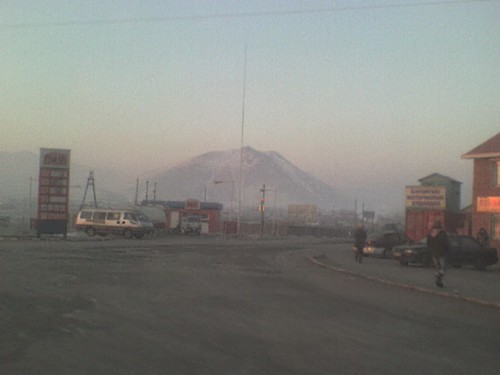
In a recent meeting, my mentor, Professor Dagshigdorj, apparently struggling for a theme about which to seek advice, asked; "What can we do about the smoke problem?"
Western Ulaanbaatar, where our school is located in a peri-urban ger district sprawl, is particularly beset by smog problems in winter. The poor air quality is unhealthy and visibility is very poor at the current -20C temperatures. In the absence of wind, the basin setting of UB, with its five surrounding mountains, contains the low lying smog created by the city heating, traffic and power stations, and usually attributed to the ger districts' many coal fired stoves. "Did I have any relevant experience in the developed world?" I thought quickly, Graz has similar air quality problems, also the implementation of London's Clean Air Act in 1956 (and over the last 50 years) would be relevant, as would the ozone hole in Australia and subsequent carbon minimisation legislation in the construction industry.. a very broad topic. We resolved to unravel and discuss these further.
Our college had also recently been called upon by World Vision's local Bayankhoshuu district branch to advise on developing a model Energy Efficient House. Passive design, active technologies and materials would all be taken into account. In this school, however, Mongolian professionals' knowledge of techniques of auditing energy consumption and building efficiency at design stages seem to be limited. Life-cycle costing, to account for payback time of energy efficient design, also appears to be an unfamiliar concept. We need to develop this capacity in the school staff, but time is short.
As a coincidence, it emerged that World Vision is planning to develop an Independent Living Centre, potentially duplicating efforts with the Mongolian Wheelchair Users Association (MTIX), mentioned in the previous blog entry.
Weekly subject group curriculum development meetings have now been planned, but postponed. Tonight I hope to meet representatives of the Blue Sun Contemporary Art Group, who this Summer in UB are to show the inflatable works of Ana Rewakowicz, a Canadian artist colleague whose new monograph I am currently reviewing.
Saturday, January 05, 2008
A Friday

Yesterday seemed a relatively effective workday, two out of four planned meetings eventuated. I went to the VSO offices for a morning meeting which had already been twice postponed, with MTIX, the Mongolian Wheelchair Users Association, ostensibly about design for Independent Living. I took a microbus from Khar Khorin market, near my apartment, to Boemboegoer market in the city centre, (about half an hour) then walked to Seoul Street and caught a taxi for another mile to a place with a shortcut path to VSO's offices at Crystal House Business Centre. (Total 300 + 500 togrogs = 35p) My Building College colleague and translator Ariunaa was waiting in the lobby, and after unlocking the meeting room, I printed my prepared notes on Design for Independent Living fro the internet in the volunteer's room. Disability expert Nickson Kakiri, our new VSO volunteer joined the meeting, and we were then summoned to help bring Chuluundolgor and Avirmed of the MTIX up four flights of stairs to the meeting room.
The meeting focussed as much on the need for a business plan to pursue MTIX's wish for developing an Independent Living Centre in Mongolia as it did on capacity building or expertise skill sharing. Very few wheelchair users, Chuluundolgor suggested, let alone professionals and the public, were aware of the potential for Independent Living for disabled people in Mongolia,and the art and science of designing and adapting buildings for people with various limited physical abilities. We discussed the politcal problems of fundraising and government 'obstructions' and Nickson shared his international experience. We resolved to plan some training for those interested in Design for Independent Living principles. I recommended a Mongolian architect expert from the University MUST, and an architect steering committee member of the nascent Mongolian Architects Association, as well as a Construction Ministry contact.
After this meeting Ariunaa and I returned to the college after a detour to a bank. She explained she helps a friend in the remote Dornod province by collecting and sending his chemotherapy treatment from Ulaanbaatar. After collecting funds and visiting the central pharmacy with a prescription, she rises early to go to a microbus station where a messenger, usually a Dornod 'neighbour' will cheaply convey the valuable syringes to her friend.
Returning to the Construction College on time, our planned meeting, for which I had prepared notes on an Energy Efficient House pilot scheme with World Vision, had been cancelled. I had a brief meeting about my proposal for teacher training at Darkhan Construction College, and the planned subsequent English training was also cancelled, with rumours of a teachers' crisis meeting.
New Year - Shin Jil

I finally understood what all the palaver had been about, with teachers reportedly rehearsing routines until 11pm at night etc., when I attended the college New Years party, which featured speeches, several performances, four or five costume changes and elaborate evening dress. Fortunately I wore a tie. Surprisingly for a college with some of the worst maintained toilet facilities I've seen, taped up dirty hand basins, and unevenly sized stair risers, there were generous cash prizes for the best teachers in the vocational courses and the professional courses, and a car for one of the general staff. The glittering party at a small restaurant called Khanbi Oergoe entailed many toasts, of champagne, the ever-present vodka, and wine and beer. There was food but the evening was dominated by speeches and presentations with performances of dancing santas and scantily clad female colleagues, of dancing and socialising. I hardly remember ever being so popular as when I brought photographs (www.flickr.com/ctc2008) of the evening to the college in the new year.
The glamorous evening made a wonderful contrast with the ensuing days spent at a remote Ger camp in Terelj national park to the east of the city. A few hours after leaving the city on Sunday morning we were walking around a monastery high on the south face of a beautiful mountain. Arriving at the Ger camp belonging to a certain Bold who had travelled with us from UB, we sat around the Ger stove and drank Mongolian milk tea. Reading (Tim Winton's Dirt Music) and knitting filled the time between feeding the stove and collecting water and firewood. We rode the herder's horse around and collected dry dead wood from the snow, then built a bonfire on the frozen Terelj River (assured it would not be affected by the fire heat) The New Year countdown (not usually marked in the countryside) was marked by a visit from the neighbouring herder Narantsteseg, with whom we danced and sang around the remains of the bonfire. Toileting in the snow on this -30 degree cold dark night was made well worth the effort by the incredible night starscape.
Monday, December 24, 2007
Merry Christmas
 For the last few years in London, I have been volunteering at my local section of Crisis Open Christmas, that great institution which shelters and entertains thousands of homeless people every year, I was wondering what to do now that I am a full time volunteer in Mongolia, and with so many homeless people in Ulaanbaatar.
On Friday we had a very enjoyable little birthday party at UB Deli for Zuhura, a Tanzanian-born English volunteer with some Mongolians and international friends, including our newly arrived Kenyan volunteer Nickson, and lively conversations in English, Mongolian, Contact signing, and American and Mongolian sign languages.
Returning after the party slightly merrier from a few glasses of red wine, we noticed at our neighbouring apartment block on Bariilgachni Gudamch (Builders Avenue) a chap on his back on the cold gravel, inadequately dressed in t-shirt and open cardigan for the -20 degree night. A merry Mongolian trio walking just ahead of us shouted back to him, presumably along the lines of "what the devil are you doing, fool? - get up, you will freeze to death there, where do you live?"
I was hesitant after the experience I recounted on 22 November in another day closes .. but I watched on as the two women, despite their male companion's reluctance, came closer and shouted again, without a satisfactory response. Another Mongolian woman, well dressed in furs, then came walking up to the group. Through some sort of non-verbal communication, she and I then took an arm each and dragged the staggering man to entrance ten of block 23, where we live at entrance five. After some negotiations by the group with the guard at the entrance, the guard seemed to agree to his need to recover in the warmer stairwell. I hope he survived the night, to remember that he was somebody's father, brother, son or friend.
Meanwhile we will have a peaceful and quiet Christmas at home, thankful that our family, friends and colleagues are warm and happy.
Friday, December 21, 2007
Connecting

"I forgot" was the response when I asked my colleague what happened about a meeting we had arranged the previous evening. I can hardly believe someone can forget a meeting within a few hours. It was the same reason given by the college director immediately after avoiding a pre-arranged staff English language CPD session. One is tempted to feel offended, but there is a cultural issue here. The last couple of weeks have been difficult. Today I asked three students why they did not attend a meeting on the 12th, as confirmed in writing on the 10th. Being too busy, another appointment, etc were given as vague reasons.
Fourth year students are busy finishing studio projects today, (prematurely) inking their final plans for design projects. The lecture discussion last week - including my Wagga Wagga Civic Centre case study - about diagram analysis seem to have been in vain. Clearly, these students can produce drawings of buildings, but the design process is seen as entirely linear, and the sketches and site analysis (if any exist) seem to have been abandoned when 'drawing up'. Nothing new in Western schools. The opportunities to think laterally at a design stage about energy efficiency, accessibility, habitability, and design innovation have all been missed.
Meanwhile, a colour vinyl banner of about three by five metres (possibly 30000T or STG15 worth) has suddenly appeared in the college stairwell, promoting a competition to design a commemorative fountain for Mongolia. The site, judges and prizes are unspecified, but the A2 drawings are due on Monday. There will be a Christmas holiday on Tuesday and the following week for new year.
Wednesday, December 12, 2007
Participation and Access
Today a student came in at about 7pm, asking in Mongolian, "Багшаа" (please teacher..) and showed me a scribbled list of Mongolian words. I have no idea what she wanted. She said "Баярлалаа" (thank you) and left.

An ongoing aim of the work here is to fight disadvantage and to increase accessibility of existing resources. I believe making buildings more physically accessible is therefore instrumental. The most recent meeting of the accessible buildings group was hosted again at VSO headquarters. Although the three CTC students who had promised to present their work on accessible buidings in Western UB failed to attend, the core of the group, including Chuluundolgor (Wheelchair Users Group), Alison (VSO Director) Mr Oyunbaatar (MNFDPO President) held to the agenda of preparation for a new VSO / MNFDPO volunteer, promoting the 3 December Disability Day activities, and advocacy for accessible buildings in Mongolia.
A new pattern school for Mongolia, developed with GTZ, was discussed, being apparently accessible and in accord with the Mongolian Wheelchair Accessibility Norm. It was decided to suggest this as a model for the new CTC college buildings currently on the drawing board, also as an educational tool for CTC students.
Chuluundolgor and I reported on the Tour of UB 3 December Wheelchair 'march' and I showed a rough diagram of the barriers experienced at the seven locations. We all discussed arrangements for a new volunteer with a hearing disability and expertise in accessibility work. Chuluundolgor and I hope to do some work on Design for Independent Living soon. And to look at the accessibility of the Microdistrict Centre and School Designs with CTC students at a meeting in late February.

An ongoing aim of the work here is to fight disadvantage and to increase accessibility of existing resources. I believe making buildings more physically accessible is therefore instrumental. The most recent meeting of the accessible buildings group was hosted again at VSO headquarters. Although the three CTC students who had promised to present their work on accessible buidings in Western UB failed to attend, the core of the group, including Chuluundolgor (Wheelchair Users Group), Alison (VSO Director) Mr Oyunbaatar (MNFDPO President) held to the agenda of preparation for a new VSO / MNFDPO volunteer, promoting the 3 December Disability Day activities, and advocacy for accessible buildings in Mongolia.
A new pattern school for Mongolia, developed with GTZ, was discussed, being apparently accessible and in accord with the Mongolian Wheelchair Accessibility Norm. It was decided to suggest this as a model for the new CTC college buildings currently on the drawing board, also as an educational tool for CTC students.
Chuluundolgor and I reported on the Tour of UB 3 December Wheelchair 'march' and I showed a rough diagram of the barriers experienced at the seven locations. We all discussed arrangements for a new volunteer with a hearing disability and expertise in accessibility work. Chuluundolgor and I hope to do some work on Design for Independent Living soon. And to look at the accessibility of the Microdistrict Centre and School Designs with CTC students at a meeting in late February.
Monday, December 10, 2007
Ger district architecture
Ulaanbaatar is increasingly comprised of and surrounded by ger districts (Mongolian tent dwelling districts), the informal architecture of encampments claimed by Mongolians under their traditional right to nomadically and temporarily settle on their land, in this case close to the capital. Now more than a colonial symbol, the capital is an increasingly environmentally repulsive complex, albeit of great financial and cultural attraction for Mongolian citizens.
Dirty yet progressive, ill-equipped yet full of potential for poor migrants, the chimera of gleaming towers at the city centre attract citizens of Mongolia from the farthest corners of the vast and relatively sparsely populated Republic.
In the process, the city's solitary East-West artery, symbolic of distant connections to Russian and Chinese neighbours, is completely clogged with private and 'SUV' vehicles and ailing microbuses, buses and trolleybuses, all heaving with passengers. The 4x4 vehicles in this predominantly rural country make for a perpetual Naadam festival, parading along Peace Avenue, demonstrating 'progress' and creating havoc for pedestrian and public transport. The latter are regarded the upwardly mobile as more symbolic of the bad old solicalist times, where the streets were deserted and people queued sliently for five identical grocery items at any one of the identical grocery stores throughout the city. Now the 4x4 owners, returning from their summer camps in the countryside, complain that the smog and haze is the product of the ger district residents burning coal for heating in the informally planned peri-urban areas.
From my window in the gridded high rise apartment subdivision, I look out over the informal district to see a horse and cart loaded with belongings bound for an unsealed track to the north. One of many vapour trails from the north west leading to the south east reminds me of the extremely high technology of international jet engines, while coal smoke puffs from chimeys in the unsewered and waterless ger district.
The informal urbanism of the ger area is horizontal and rhizomic, constantly changing and metamorphosing. My north facing window in building 23 represents the threshold of the vertical gridded, arboric city system 'core'. Women and children collect water and coal while men attend to ger covers, smoking cigarettes and jockeying cars.
Besides gers there are myriad fences and gates along a labyrinth of dusty vehicle paths and footways, stretching organically over the landscape, under power lines and around drain culverts. Tiny shops appear in shacks or recycled railway carriages or shipping containers. Small hourly rate hotels, a community centre and garages are interspersed without apparent planning logic. Empty space becomes a meeting point for 'taxi' drivers to gather or for another stall. The informal architecture here is woven or knitted together, temporarily, without a concern for the future.
Dirty yet progressive, ill-equipped yet full of potential for poor migrants, the chimera of gleaming towers at the city centre attract citizens of Mongolia from the farthest corners of the vast and relatively sparsely populated Republic.
In the process, the city's solitary East-West artery, symbolic of distant connections to Russian and Chinese neighbours, is completely clogged with private and 'SUV' vehicles and ailing microbuses, buses and trolleybuses, all heaving with passengers. The 4x4 vehicles in this predominantly rural country make for a perpetual Naadam festival, parading along Peace Avenue, demonstrating 'progress' and creating havoc for pedestrian and public transport. The latter are regarded the upwardly mobile as more symbolic of the bad old solicalist times, where the streets were deserted and people queued sliently for five identical grocery items at any one of the identical grocery stores throughout the city. Now the 4x4 owners, returning from their summer camps in the countryside, complain that the smog and haze is the product of the ger district residents burning coal for heating in the informally planned peri-urban areas.
From my window in the gridded high rise apartment subdivision, I look out over the informal district to see a horse and cart loaded with belongings bound for an unsealed track to the north. One of many vapour trails from the north west leading to the south east reminds me of the extremely high technology of international jet engines, while coal smoke puffs from chimeys in the unsewered and waterless ger district.
The informal urbanism of the ger area is horizontal and rhizomic, constantly changing and metamorphosing. My north facing window in building 23 represents the threshold of the vertical gridded, arboric city system 'core'. Women and children collect water and coal while men attend to ger covers, smoking cigarettes and jockeying cars.
Besides gers there are myriad fences and gates along a labyrinth of dusty vehicle paths and footways, stretching organically over the landscape, under power lines and around drain culverts. Tiny shops appear in shacks or recycled railway carriages or shipping containers. Small hourly rate hotels, a community centre and garages are interspersed without apparent planning logic. Empty space becomes a meeting point for 'taxi' drivers to gather or for another stall. The informal architecture here is woven or knitted together, temporarily, without a concern for the future.
Construction teacher training
Encouragingly, I discovered some staff had been researching teaching materials using techniques from the first CPD seminar. A text about Robert Venturi's Vanna Venturi House was being analysed with students. A further success: about seventeen staff attended the second staff development seminar last Friday evening, and despite many threats of participants being 'too busy', we began about half an hour late, with the vice director Khashaa in attendance, after a last minute venue change and furniture reorganisation.
Our newest and youngest English teacher, Enkzaya, welcomed colleagues to the session from a script, and everyone introduced themselves by name, (often footnoting meanings of names in English translation), with their teaching roles, and in a few cases, the purposes of English at the Construction College. The last part was rather difficult for many to express, but a bright first year student called Lhagva spoke to the group about the English-speaking walk she had attended with me, representing our college with a group from the University of Humanities.
Each teacher took a turn at translating part of Lhagva's story about the walk from Chinggis Khan Airport to Chinggis Khuree camp, and the subsequent litter collecting stop, on a cold sunny November day. Most staff were reluctant to commit to further training, but the session had been satisfyingly interactive and positive.
Our newest and youngest English teacher, Enkzaya, welcomed colleagues to the session from a script, and everyone introduced themselves by name, (often footnoting meanings of names in English translation), with their teaching roles, and in a few cases, the purposes of English at the Construction College. The last part was rather difficult for many to express, but a bright first year student called Lhagva spoke to the group about the English-speaking walk she had attended with me, representing our college with a group from the University of Humanities.
Each teacher took a turn at translating part of Lhagva's story about the walk from Chinggis Khan Airport to Chinggis Khuree camp, and the subsequent litter collecting stop, on a cold sunny November day. Most staff were reluctant to commit to further training, but the session had been satisfyingly interactive and positive.
Tuesday, December 04, 2007
Wheelchair-users City Tour / Rollstuhlfahrerstadtrundfahrt
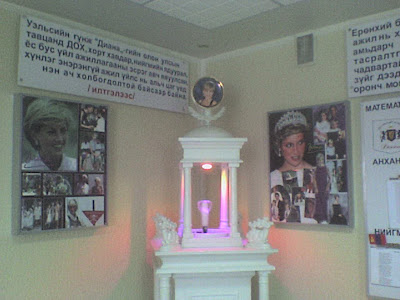

Yesterday was International Disability Day. I took part in a well planned campaign of the Mongolian Whellechair Users Association. (I wore my CTC branded jacket, Boss!) The Wheelchair association chair Chuluundolgor, (with whom I am working, via VSO, on architecture accessibility norms and 'independent living'), organised a 'Tour of Our City, UB' with help of one Tsevelmaa. Fourteen wheelchair users visited (by prior arrangement) seven publicly accessible buildings in the city on the tour. After opening speeches at the 'Open Society Forum' the group, including busness leaders, researchers, fitness teachers and computer workers, wheeled through heavy UB traffic on the cold and sunny morning to the bus parking. Volunteers lifted eight at most into each of two rented City Buses. The Brewery visit, with lab capes, was crowded, and very noisy in the bottle filling hall, but apart from the entry steps, was straightforward.
The next stop, Bayar's Construction, was actually held at 'Diana' school, and despite the founding principles of the funder (to fight exclusion of poor and disabled children) all participants had to climb five entry steps, then over a stage blocking the doorway. The programme, entertainment from pupils, and food and drink were great. Interviewed about my impressions as a foreign expert and architect on my departure, however, I had to say the physical barriers were a major problem for the visit. At the Mongolian Youth Federation, everyone had to go up two flights of stairs, with other building users shoving their way past, to a first storey meeting room and a comprehensive powerpoint presentation. A the next visit, Mongolia's biggest mobile phone company, there were good ramps, floors andcloakroom, and telephone credits were given out.
At the City Governors, temporary wooden ramps had been emplaced on the six stairs in the entry lobby, and down a few more into the public meeting room. As with the building firm, the hosts seemed not to recognise the 2002 building norm (31-101-04) for wheelchair users. Nice books about the City of Ulaanbaatar were presented, but little hope was instilled for improving the state of accessibility of UB streets and buildings. He apologised that the officially counted 18032 disabled people represented a minority in the Market Economy, while an actvist beside me suggested 35-70 thousand would be a more accurate national figure.
Finally, to Tengis Cinema, founded 2002, where I had previously overlooked so many steps. We carried the fourteen wheelchair users down from the busses, through the busy parking
area, 8 steps to the entrance, then two long flights of stairs to ticketing and cinema entrance. I admired everyone's patience as I saw one wheelchair user manhandled to the inaccessible toilet. The Cinema Manager was responsive and friendly, and after a glas of champagne, everyone sat in the front of the cinema and enjoyed a new Mongolian Film.
(German version)
Den Direktor unserer Schule, D. Gankhuyag moechte ich ermoeglichen, dieses Blog zu lesen; deshalb ist es nun bisprachig hergestellt. Gankhuyag hatte vor '92 in Russland und Deutschland studiert, hat aber, wie meine restlichen kollegen hier, findet wenig zeit, Englisch weder zu lesen, noch zu lernen.
Gestern war Internazionale Tag der Behinderten Menschen. Ich nahm an eine sehr gutgeplanten Aktion des 'Mongolischen Vereins der Rollstuhlfahrer' teil. (in meine gebrandeten Jacke, Chef) Vereinsvorstand Chuluundolgor, (mit der ich bereits an architekturnormen und 'accessible living' durch VSO zusammenarbeite), hat mit hilfe der Tsevelmaa, eine 'Rundfahrt unsere Stadt, UB', georganisiert. Vierzehn rollstuhlfahrer-innen schliessten seiben oeffentlichen gebaueden an diesen Tag in ihrem rundfahrt ein. Nach dem eroeffnungstreffen im 'Open Society Forum' fuhren die gruppe- geschaeftsleiter, forscher, fitness lehrer, EDV arbeiter- durch der dicht verkehrten strassen an den kalten sonnigen morgen zum Busparkplatz. Dann hiebten die freiwilligen jeweils hoechstens acht rollstuhlfahrer-innen in zwei vermiteten Linienautobuessen hoch. Der Brauereibesuch ging, mit weissen kleiden angezogen, sehr dicht beieinander, sehr laut im flaschenfuellungshalle, aber ausser der eingangstreppe, relativ einfach.
Naechster haltestelle 'Bayars Construction' fand eigentlich in der 'Prinzessin Diana' Mittelschule statt, und trotz des grundprinzip des Diana Funds (gegen ausschliessung der behinderten in armen laendern), muessten alle teilnehmer fuenf treppen, dann eine der Tur blockierenden Buehne, ueberklettern. Das programm, unterhalten der schueler, und das essen und waren sehr gut. Beim abschied aber, auf anfrage meines gesamteindrucks als fremden 'Experte' leider beantworten, dass die physikalische barriere den besuch sehr schwierig machten. Bei den Mongolischen Jugendverein muste allen sogar zwei treppenlauefen im ersten stock hochgehoben werden, waehrend vielen vereinsangehoerigen vorbei drangten, um einen powerpoint-praesentation in einem schoenen saal zu erleben. Beim naechsten besuch, an der Mongolei's grossten Handy-firma Mobicom, gab es gute rampen, boden und Garderobe, und telefonkredite wurden geschenkt.
Zur Stadtgouverneur; kuerzweiligen holzrampen gingen ueber sechs treppen hoch dann wieder drei runter, alle kamen dicht zur hauptbesprechungssaal hinein. Wie beim Baufirma, erkannten die Gastgeber die baunormen fuer rollstuehle (31-101-04) scheinbar nicht. Sie bieteten schoene bueche uber den Hauptstadt an, weniger hoffnung teilten Sie aber, fuer die verbesserung der strassen- und gebaueden-begehbarkeit des Hauptstadts. Der Stadtgouverneur entschuldigt sich dass 20 tausend der zahlbaren Mongolischen behinderten sei im Markt-Oekonomie eine minderheitssache, wahren einen aktivisten-kollege schaetzt 35-70 tausend wohnen hier.
Schiesslich zum Tengis Kino, im 2002 gegruendet, wo ich frueher gar nicht gemerkt habe, dass so viele treppen stehen. Hier hiebten wir die vierzehn kollegen aus der buessen nieder, durch parkplatzverkehr, 8 treppen zur eingangs portal hoch, dann zwei lange treppenlaufe zur Kasse und Kinoeingang auf. Ich bewunderte alle, wie ich ein rollstuhlfahrer sah, der im WC koerperlich zur toilette behandelt werden musste. Der Kinomanager war sympatisch, und nach ein glas sekt, sassen alle im vorigen reihe des Kinos und geniessten ein Mongolischer Film.
Thursday, November 29, 2007
Visiting MUST

A visit to the Mongolian University of Science and Technology has been on my agenda since my departure, and yesterday I met with Purev-Erdene Ershuu, architect and lecturer at the Centre for Architectural Research and Design at this university. The meeting had taken several weeks to organise, with much help from Munkhzhul Choiljiljav, former London Metropolitan University architecture student and AA school applicant. With both Munkhzhul and my CTC interpreter Ariunaa in my entourage, Purev outlined the Mongolian architectural education scene in fluent English. The largest of four construction education institutions in Ulaanbaatar, MUST's architecture school has a population of about four hundred students, having increased threefold since 1995. There are two graduating cohorts each year, about twenty in total, and an intake of about one hundred. Purev says a high attrition rate is necessary to maintain a high standard.
With the currently buoyant construction industry producing high demand, almost all graduates apparently find work in Mongolia. The curriculum is understandably influenced by the history of collaboration with Russian universities. Russian language is still a compulsory subject, and the language of many textbooks. However Purev claims the curriculum structure is largely based on the German system, because of the strong links there. The studio master system has been replaced, however, by team teaching, in order to cope with the staff student ratio for 14 full time staff like Purev. Russian 'didactic' teaching methods are criticised but still present, and the university sees design workshops as seminars rather than as a separate delivery method western universities call 'studio'. There is interest in English-language architecture and culture. International links include Korean (KOICA) and Japanese (JAICA) volunteers and exchanges in the school, a Romanian exchange project, and a link with Vienna University of Technology. I was aware of the latter through my contact with Prof Erich Lehner, at the Department of 'Extra-European architecture' (Ausser-europaeischer Baukunst), who, with Viennese students, has been partner in an ongoing project in a ger district.
A member of the eleven-strong steering committee of the Mongolian Association of Architects (Mong. Arkh. Kholboo), Purev expressed frustration that as there is no protection or promotion of title here, and that the association is 'symbolic' and 'dormant'. Similarly, architecture-allied careers like drafter, technologist, historian and built environment educator are not professionalised. It was a very useful meeting and my collegue Ariunaa claimed that finding a kindred spirit had made me happier than she had ever seen me. My hopes for learning more about the advisory role of the Mongolian Association of Architects or MUST in continuing professional development and curriculum development are, for the moment, however, dashed...
Resourceful
As I noticed the stray dog's tongue probing the eye socket of a discarded sheeps skull in the street, I wondered at the tenacity of his search for nourishment. Sheep's head being a local delicacy, the skull had probably been well picked by humans days before. Walking on through the ger district towards my work, I passed three men heaving a reluctant sedan into motion, a four wheel drive towing a belching lorry, and a well dressed woman with a bright red hat and immaculate make-up, walking in high heels on the dusty lane toward the city. Approaching the community centre on a hilltop, there was a gathering of people with water carrying equipment and bright sun illuminated the cold scene. A boy approached me, speechless, with an extended hand..
Thursday, November 22, 2007
another day closes
I alighted at my local bus stop (Khar Khorin Market) from a crowded microbus returning from work, and was bid good-bye by a particularly friendly conductor. I saw at the edge of the cold and crowded pavement a fellow, younger than I, but roughly dressed, spreadeagled on his back. Rough sleepers usually choose a warmer pose and some sunlight, given the sub-zero air temperature. I wondered if the man had been injured or had been the victim of a traffic accident, and looked on to see if he was breathing, as bus conductors and passers-by gestured not to look at him. One other young male bystander in the crowd seemed to share my concern and indicated he was phoning for 'a doctor' - he agreed to help me turn the casualty into what I understand from my basic first aid as a 'recovery position'. I felt for some faint warm breath at his nose, but there was no pulse and he was becoming colder. The traffic policeman attended but showed no interest in touching or moving the body. My collaborator gestured resolutely that we should say prayers.
Tuesday, November 20, 2007
Hospitals and Air-Con
 At the top-level architecture studio lesson on Monday, I used the available teaching technology (paper on blackboard) to explain the principles of hospital planning, including workflow diagramming and functional relationship diagramming. The masonite blackboard surface has no tooth and the cheap chalk at the college crumbles at the touch, so that staff have to bring their own. I had prepared a schedule of about 14 functions and spaces from 'triage' to 'ward' to 'morgue' in Mongolian translation, and with my cartoons, students arranged and discussed the architectural requirements for each. I drew on EU examples from the UK 'architects for health' valuable website and showed some of the materials published there. However, the case study material I had translated from Bern's Small Animal Clinic (recently featured here on French cable TV) proved too complex for this lesson.
A construction sequence was discussed, with emphasis on the design brief development, facility management for uninterrupted service, and installation and commission of specialised equipment, and with a particular student interest in Crematoria and emissions. The students were most interested in the concept of air conditioning and mechanical ventilation which they had not experienced in Mongolia, and they were surprised to learn that these occupied extensive courses in many foreign architecture schools.
Subscribe to:
Posts (Atom)


